

I’m all over the place when writing. I alternate between being totally unable to focus on the task at hand, and marathon sessions where I don’t want to do anything other than lose myself in my manuscript. Out of curiosity, I decided to google methods to remain focused.
Of course, every article I found started off with a list of why writing with ADHD is a challenge. These issues include: difficulty getting organized, staying focused, a lack of attention to details, a tendency to procrastinate, and a tendency to be easily distracted by unrelated thoughts or stimuli. (Oh, look, a squirrel! No, for real, a squirrel just ran up the tree outside of the window…)
How in the world, then, are we to stay attentive to our writing—or. in fact, to any other task or creative endeavor—when ADHD is involved? And further, how can we do so as adults, when everything found online either deals with young children and/or requires prescription medication?
After careful consideration, I found ways to adapt the articles I’d discovered about helping children with ADHD to complete written assignments. Here are eight ideas to help us as writers.
Get clear, concise directions.
For professional writing projects, make sure you clearly understand your supervisor’s expectations. Take concise notes and ask questions as necessary.
With more creative writing projects, you will want to check into the tropes and rules of the genre—for example, the desired word count for a romance novel, depending on the niche, is anywhere from 40,000 to 100,000 words. And a romance absolutely must have a happily ever after.
Either way, knowing the rules from the start can help you stay focused on the final outcome.
Get organized from the start.
Begin with organizing your space. Remove the unnecessary distractions. Yes, with ADHD we do have some necessary distractions, the ones which somehow help us to stay focused by occupying the part of our brains that wants to be off-task. So while I can’t remove the background noise of the TV or music, I definitely can turn the phone face-down so I’m less likely to play a game.
From there, organize the project. My one best friend has a wall of color-coded sticky notes, detailing each chapter’s events. My other best friend uses a notebook and different color pens. I use calendar pages to track out my characters’ timelines. Whether you like any of those resources or any of the multiple digital tools such as Autocrit or Grammarly, this level of organization is essential.
Start slow and create small, manageable goals.
This is meant to address the “H” in ADHD. Decide that your goal is to write two sentences. From there, see if you can get to a full paragraph. Or perhaps set a goal of writing a hundred words by the end of the weekend. Make it manageable.
Allow for procrastination.
Look, you know yourself. Don’t set deadlines that are unreasonable to your modus operandi. Or if there is a deadline from elsewhere, diversify your work on the project. Alternate research, discussion with colleagues, and editing with your writing.
Write in a journal.
Writing in a journal of any sort helps you develop the habit and discipline of writing. Further, this is one of my favorite ways to allow for my ADHD. A handwritten journal allows me to doodle, cross out, color-code, use script or print. Further, it lets me really connect physically with my work in a way that keeps me grounded.
Use technology to your advantage.
There are various sites that offer writing support software, a couple of which are listed above. However, you can also use tools such as spell-check, the thesaurus function, and text prediction in MS Word. And almost every digital device now offers voice recognition, which allows so many opportunities for creativity with ADHD. I wrote three sections of my current work-in-progress by voice while driving to my brother’s house four hours away for Thanksgiving dinner.
Review your work line-by-line.
A good writing friend of mine swears by having Siri read her manuscript back to her, one sentence at a time. I read mine aloud to myself. A writers’ group I belong to has small group sessions where we read one another’s work aloud. This act of reviewing your work, line by line, allows for catching details and mistakes you might have otherwise missed—mistakes which even the neurotypical make frequently.
In the end, while there is no “right” way to write, each of the above can help you focus and get your work into a more structured routine which will help you to accomplish your writing goals. Good luck and keep writing!
Oh, and as a side note: while writing this post, I played with my best friend’s dog five times, edited a page on my website, checked Facebook approximately nine hundred times, deleted a few items from Instagram, ate lunch, had a snack, ordered some promotional items, and cracked jokes about a Hallmark movie that’s on the TV… so yeah, I could use a few more of these tools in my repertoire.
Photo credit:
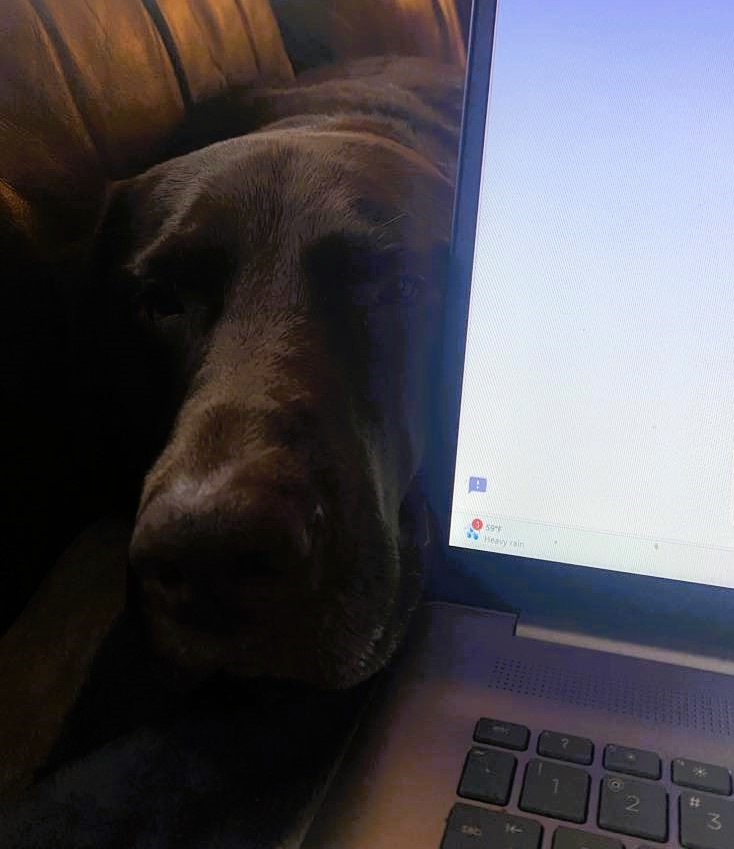
Rouxbee Law (chocolate lab and writing buddy, belonging to Christine Guidry Law – Author – Historian – Cultural Activist)
Resources: